HackYeah 2026 · Sport & Healthcare challenge
Lemi: health care without the stress
Lemi is a health guide with a friendly lemur. It helps every day and at every doctor's visit: it joins mood, movement, medication, measurements and test results, and turns them into one small step for today.
The problem
People put off the doctor because of the phone call, the ten minutes and the advice they forget.
What I built
A web app and a Flutter app on the Claude API and ElevenLabs, designed and coded at the hackathon.
Signature move
One recorded visit becomes three summaries: for you, for family, for the doctor.
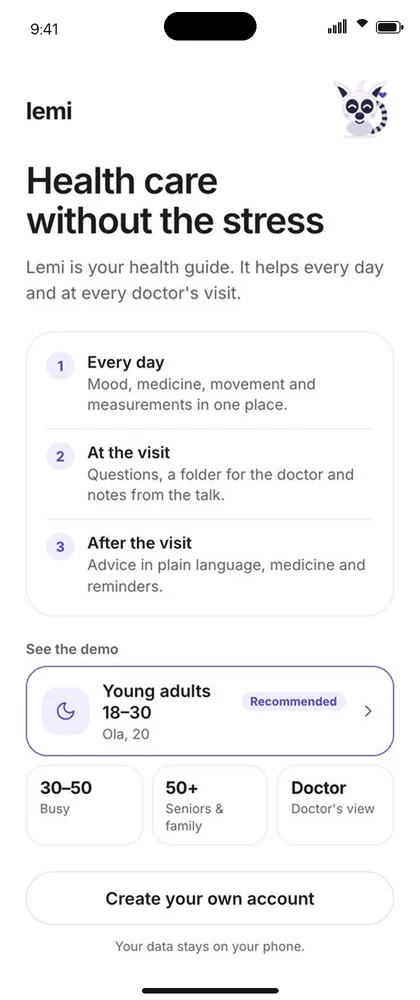
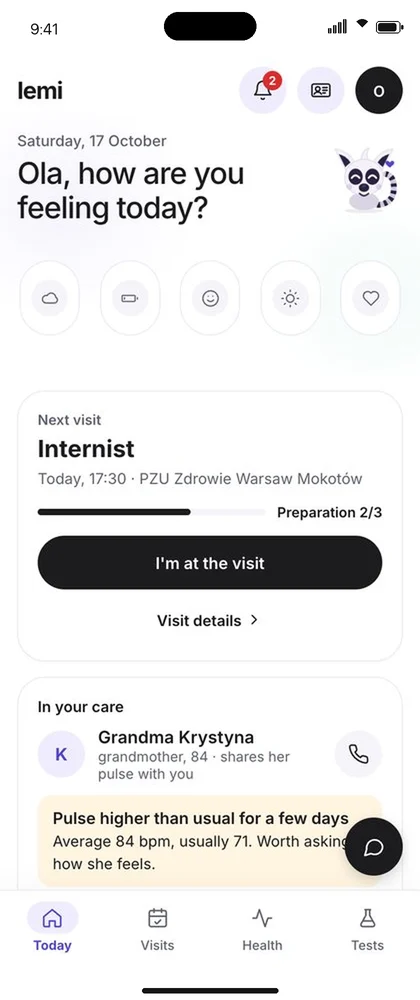
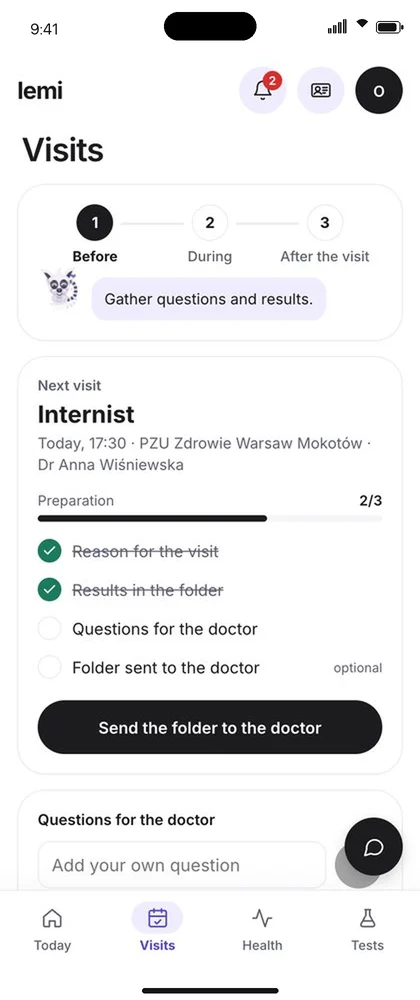
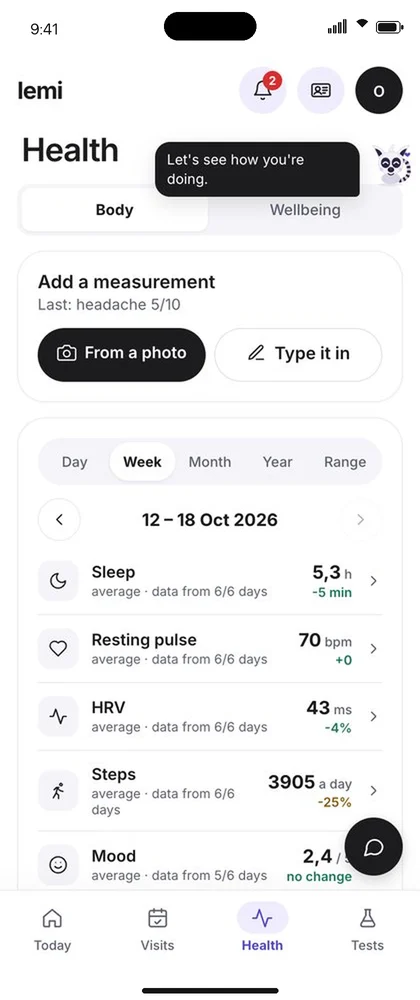
Shown in English for this page; the demo runs in Polish.
Where it started
It started with me. I'm a student and I put off calling the doctor, not because I don't know what is wrong, but because I have to call, explain myself, remember everything in ten minutes and then keep track of the advice.
At the hackathon I asked other people whether they felt the same. It was far more common than I thought, and each conversation added a group the app could help: people for whom Polish is not a first language, people with disabilities, neurodivergent people, seniors and their families, and people with health anxiety.
A doctor's visit in three steps
Before
Questions for the doctor are drafted from your own data, and a folder reaches the doctor before the visit. In beta, an AI voice agent can call the reception for you and introduces itself as AI.
During
With the doctor's consent, live transcription turns the conversation into text, ticks off your questions and explains difficult words. "Show instead of tell" screens help at the reception desk.
After
A summary in three versions: for you, for someone close to you and for the doctor. Advice turns into tasks and reminders, including e-prescriptions that are about to expire.
Every day
- Mood in one tap, with Lemi the lemur reacting across the app.
- Medication with reminders, and movement that starts from what is realistic, with WHO's 150 minutes a week as the goal.
- Measurements from a photo: blood pressure monitor, glucometer, scale or thermometer. AI reads the display and you confirm the value.
- Health over time: sleep, heart rate, heart-rate variability, steps, mood and measurements by day, week, month or year.
- Connections between data, for example worse sleep, lower mood and a test result worth raising with a doctor.
- Test results from a PDF or a photo, with every parameter explained in plain language.
Mental health, carefully
- Short mood and anxiety check-ins (PHQ-9 and GAD-7) when a doctor recommends them, every two weeks, with a chart to show a doctor or psychologist.
- A calm mode for health anxiety: no percentages and no red labels.
- When someone circles the same symptoms, Lemi stops adding AI answers and suggests a question for the doctor and a talk with someone close.
- A crisis path, with 112 and a helpline always at hand.
Accessibility and AI that behaves
Accessibility
Built to WCAG 2.2 level AA; an automated axe-core check on 14 screens found no errors.
"My needs" adapts the app for ADHD, autism, dyslexia, colour blindness, low vision and hearing, limited mobility and eating disorders, for example by hiding weight.
AI rules (AI Act, GDPR)
You always know when AI is at work. AI does not diagnose or give doses, and every entry, visit and email waits for your approval.
Sudden symptoms are caught before the model and lead straight to 112. Without API keys the app runs in a rule-based demo mode.
How it is built
| Part | What it uses |
|---|---|
| Assistant, PDF results, visit summary | Claude Sonnet (Anthropic) |
| Reading a measurement from a photo, live mode, tip of the day | Claude Haiku (Anthropic) |
| Speech to text | ElevenLabs Scribe, with the Web Speech API as a fallback |
| Front-end | React, TypeScript and Vite, installable as a PWA; a native Flutter app shares the same API |
| Back-end | Serverless functions on Vercel |
| Privacy | Health data stays on the phone; sharing, the QR code and the doctor's folder are encrypted with AES-GCM; export for doctors in HL7 FHIR |
Try it
Open the demo and pick Young adults 18–30 (Ola, 20). Other accounts: 30–50 (Marek, higher blood pressure), 50+ (Halina, simple mode with large text) and a doctor's view. All characters and data in the demo are fictional.